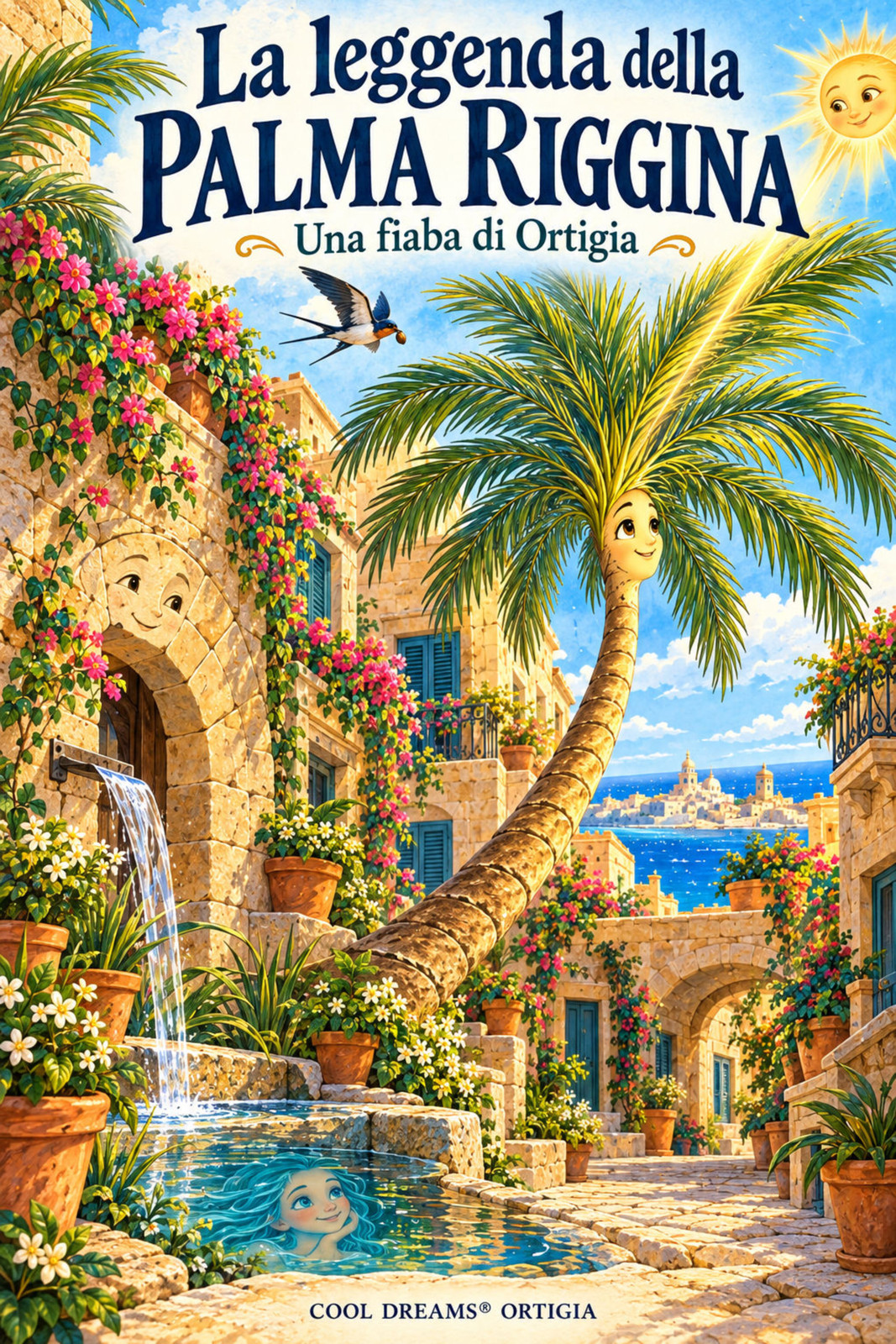
A palm, a story to take home.
Our legend becomes an illustrated story to enjoy together, even after you return home.
Browse the story
Download the PDF
Choose a language
Preview in Italian

From the legend of the Palma Riggina.
“You do not wait for the light: you reach for it.”
The palm you see in the courtyard inspired a contemporary legend, born here at Cool Dreams. Within the story are the voice of the stone, the waters of Aretusa and a tree finding its own way towards the sun.
“Cu’ veni cca, porta ’na storia. Cu’ si nni va, nni lassa n’autra.”
Whoever comes here brings a story. Whoever leaves, leaves another behind.
They say that, when Aretusa¹ still breathed beneath Ortigia², there was a courtyard where the light never entered. The houses around it kept it in darkness, as one keeps a secret, and the stone — together with the cool, dark waters underground — guarded it.
One day, a seed arrived from the sea. They say it was not the wind that left it there, but a weary swallow. The seed fell into the courtyard, between two ancient slabs, and did something no one expects of a plant: it listened.
For that courtyard could speak. And it said: “Hold on!”
It spoke softly, as old walls do: through cracks, through damp, through echoes. Every stone had a story: promises beneath the arches, silent farewells, returns understood in a glance, names caught in the throat.
Everything ended there, in the darkness, and everything stayed there… until the seed answered in its own language: by growing.
But the light was far away. And so the palm did what heroes do when destiny calls: it bent. Not in surrender, but to find a way.
Its trunk took on a strange slant, as though it were crossing the air. Every night it shifted by a breath, searching for a gap between the roofs. The stones watched, and the courtyard — which had no sunlight — began to have hope.
The palm grew crooked. Not through a flaw, but by choice. It sought the light as one seeks a truth: feeling its way, taking wrong turns, persisting. And the shadow, instead of holding it back, kept it company.
“Do not go,” said one stone. “Go,” said another. “Take care,” said the arch. “Seek,” said the sea, far away.
One morning, Helios³ passed high over the island and saw, in the shadows, a green creature reaching its heart towards him. He was moved. Not out of vanity, but out of respect: for light does not love those who possess it… it loves those who seek it.
And so he let fall a gift as small as a promise: a thread of sunlight. Not a full beam, not a triumph: a slender blade that entered the courtyard at an angle, for a few hours each day — brief, but faithful.
The palm felt it and changed its rhythm: where it had been a question, it became an answer; where it had leaned, it rose upright. They say that from that day on it feared nothing, for it had learnt that you do not wait for the light: you reach for it.
And it climbed. Higher still. Until the sky seemed close, as though it were a bell tower made of leaves.
Aretusa¹, below, heard that rustling and recognised the sound that springs know: the sound of wishes finding their way.
But Ortigia², as everyone knows, leaves nothing without a story. For here the stones speak. And when Helios³ returned to visit that courtyard — briefly each day, but faithfully — the walls began to murmur: of stolen meetings, of promises, of returns. The palm — a sentinel of leaves — caught those voices and entrusted them to the wind.
People passing by laughed and said: “Ccà si fa cuttigghiu⁴” — “There is gossiping here.” And the palm, with its crooked back and its head towards the sky, became the queen of that murmuring.
That is how the name was born: “Cuttigghiu⁴ dâ Palma Riggina” — the Courtyard of the Queen Palm.
Then, many years later, Kaleido⁵ brought singing water: a cascade. The water slipped into the stone and, at last, the stone ceased to be only shadow: it became an oasis. Tropical greenery took its place, and the courtyard breathed as though the Mediterranean had suddenly remembered that it was also jungle, also a warm island, also a dream.
And the palm, which had learnt Helios³’s lesson, did the only thing a sentinel does when the world changes: it stayed… and pointed the way.
So those who enter today, if they remain quiet, can hear the voices: Aretusa¹ saying “remember”, Helios³ saying “seek”, the water saying “slow down”, and the palm answering: “find your light”.
And if you stay still long enough, you can also hear the courtyard whisper, with a smile of stone:
“Cu’ veni cca, porta ’na storia. Cu’ si nni va, nni lassa n’autra.” — Whoever comes here brings a story. Whoever leaves, leaves another behind.
Browse the preview and download the PDF in your language, from the eleven editions available.
Our legend becomes an illustrated story to enjoy together, even after you return home.
Choose a language
Preview in Italian
| Reference | Meaning |
|---|---|
| ¹ Aretusa | nymph and spring that symbolise Ortigia; a legend connected to the water flowing beneath the island. |
| ² Ortigia | island and district of Syracuse, the city’s historic and mythical heart. |
| ³ Helios | the Sun in Greek mythology, a figure of the light that returns each day. |
| ⁴ Cuttigghiu (Sicilian) | courtyard · murmuring · gossip (affectionate chatter: voices that circulate and become a story). |
| ⁵ Kaleido | the architecture practice responsible for restoring and transforming the building. |